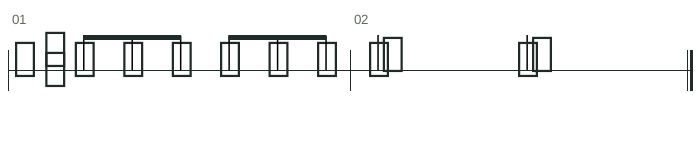
Feel two large beats, each divided into three. Compare six eighth notes with two dotted-quarter notes.
Show counting key
Measure 1: clap 1 la li 2 la li, with a gentle emphasis on 1 and 2. Measure 2: clap on 1 and 2 only; each dotted quarter lasts for one complete la-li group. The playback tempo is dotted-quarter beats per minute.
A measure of 6/8 contains six eighth-note units. In its usual compound-duple feel, these form two groups of three. Each large beat is a dotted quarter note, which lasts as long as three eighth notes.
This is why 6/8 and 3/4 do not usually feel the same, even though both measures contain the same total written duration. In 3/4, the usual grouping is three quarter-note beats, each divided in two. In 6/8, it is two dotted-quarter beats, each divided in three.
Six subdivisions, two groups
ONE two three · FOUR five six
Count the subdivisions, then feel the phrase
Counting all six eighth-note units is useful while learning a pattern. Once it is comfortable, try “1 la li, 2 la li” to connect the same six subdivisions to two larger beats. Use whichever syllables let you keep the divisions equal.
A quarter note in 6/8 lasts two eighth-note units. A dotted quarter lasts a whole large beat. Keep counting inside those held values; the rhythm should not rush simply because fewer notes are written.
An alternative two-beat count
1 la li · 2 la li
Avoid the common 6/8 traps
Do not automatically read each written eighth note as one of six equally strong beats. Let subdivisions 1 and 4 anchor the two groups. A rest may remove a sound from a strong position, but it does not remove that position from the measure.
Be precise about tempo markings. A dotted-quarter BPM value measures the two large beats, while an eighth-note BPM value measures all six subdivisions. Those numbers describe different pulses. When comparing recordings or metronomes, check which note value each one uses.
Start slowly enough to hear three equal subdivisions inside each large beat.
Count through rests instead of compressing the silent space.
Return to the two-group feel after practising a difficult fragment.
Questions about 6/8 rhythm practice
How many beats are in 6/8?
The measure contains six eighth-note units, usually felt as two large dotted-quarter beats. Counting all six is useful for learning the subdivisions; feeling the two larger beats helps establish the compound-duple meter.
Is 6/8 the same as 3/4?
They contain the same total written duration but usually have different groupings. 3/4 has three quarter-note beats divided in two. 6/8 has two dotted-quarter beats divided in three.
Are the eighth notes in 6/8 triplets?
Ordinary eighth notes in 6/8 already divide a large beat into three, so they do not need a triplet marking. In 4/4, an eighth-note triplet is a marked division of one quarter-note beat into three equal parts.
Can I print these 6/8 exercises?
Open the worksheet generator and select 6/8 before generating your sheet. Use the browser print preview to check the layout, then print it or save it as a PDF where supported.