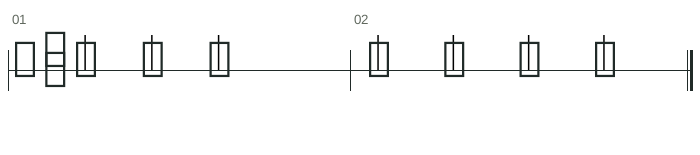
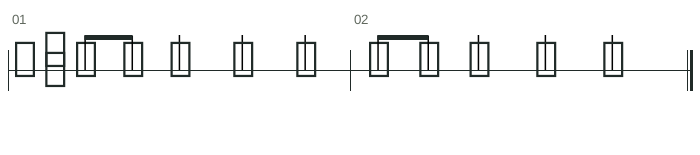
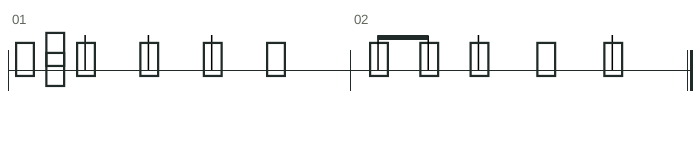
Divide the first beat into two equal eighth notes, then return to one clap on each beat.
View worked notation and counting key
Both measures: clap 1, &, 2, 3, 4. The 1 and & share the same amount of time as one quarter-note beat. Keep counting 1 & 2 & 3 & 4 & even when you do not clap every subdivision.
Choose a short exercise and a few note values you can already read. Quarter notes, eighth notes and rests are enough for a useful first dictation. Keep the time signature and tempo consistent while you learn to recognise those durations by ear.
Long exercises challenge memory as well as rhythmic hearing. If you keep losing your place, reduce the exercise length or replay it. Add one new rhythm pattern only after the simpler set feels familiar.
Separate the pulse from the sound
Keep a quiet, even tap while listening. The pulse continues underneath both notes and rests. Sketch the beat positions first, then mark which subdivisions contain a new sound. This helps you avoid treating every audible note as a new beat.
Dictation uses sustained note tones so you can hear note lengths as well as the moments when notes begin. A rest stops the rhythm tone while the beat continues. The count-in and metronome remain short clicks; you can turn off the metronome during the exercise if those clicks distract you.
A useful beat grid in 4/4
1 & 2 & 3 & 4 &
Check your notation musically
Before revealing, add up the durations in each measure. In 4/4, they must total four quarter-note beats. Then perform your written answer and ask whether it matches the sound you remember.
Compare note starts, held lengths and rests with the revealed exercise. The displayed notation is a reference, not proof that every other spelling is wrong. Different written rhythms can preserve the same audible timing, especially when a longer value can be represented with tied shorter values. This tool does not automatically judge your answer or measure your tapping accuracy.
Choose the first and last measures of a missed pattern, turn on looping, and say its counts aloud at a slower tempo. An enabled count-in plays once before the first repetition.
Try the same exercise again before moving to a new one.
Return to visible rhythm reading if you can hear a pattern but cannot yet notate it.
Questions about rhythm dictation practice
Does this exercise grade my answer?
No. Write your answer on paper or in your own notation software, then reveal the generated notation and check it yourself. The tool does not record your instrument, microphone or taps.
How many times should I listen?
Start with as many repetitions as you need. As your recognition improves, set yourself a small limit, such as three listens, before revealing. The goal is accurate hearing and notation rather than guessing quickly.
Why can I clap a rhythm but struggle to write it?
Imitation and notation are related but separate skills. You may recognise the sound without knowing which note values represent it. Slow down, mark the beat grid and practise reading those note values as well as hearing them.
What should I do after a mistake?
Compare one measure at a time. Find the first place where the note onset, duration or rest differs, count it aloud with playback, then try writing that measure again without looking.